
What do you build when the models keep changing?
Sebastian Raschka on the latest models, Nicolay Gerold on shrinking coding-agent harnesses, Chip Huyen and Tim Hopper on agent skills, plus two free lessons and a hands-on workshop next week.

Claude Code’s harness is evidence about Claude Code. It isn’t a default architecture for every agent.
My new essay Stop Overengineering Your Agent Harness starts with three questions: What must the agent do? What must it remember? What happens if it’s wrong? Answer those before reaching for memory, planning, sub-agents, orchestration, and every other feature in the standard agent-framework shopping list.
This issue follows that argument through the systems people are building now:
Nicolay Gerold on what Claude Fable and GPT-5.6 mean for coding agents, why Amp keeps deleting features, and a two-hour build of a coding agent with TypeScript and Pi
Two free Lightning Lessons on building effective agent harnesses and loop engineering without the BS
Live sessions with Sebastian Raschka on reasoning models and local agents, Hamel Husain on why you should stop shipping AI productions nobody can verify, and Chip Huyen and Tim Hopper on how they work with agents
If you want to build the complete system with me, Build AI Agents from First Principles is next week.
Live Tomorrow: What Four Months in Production Did to Maven Clinic’s Healthcare AI Agent
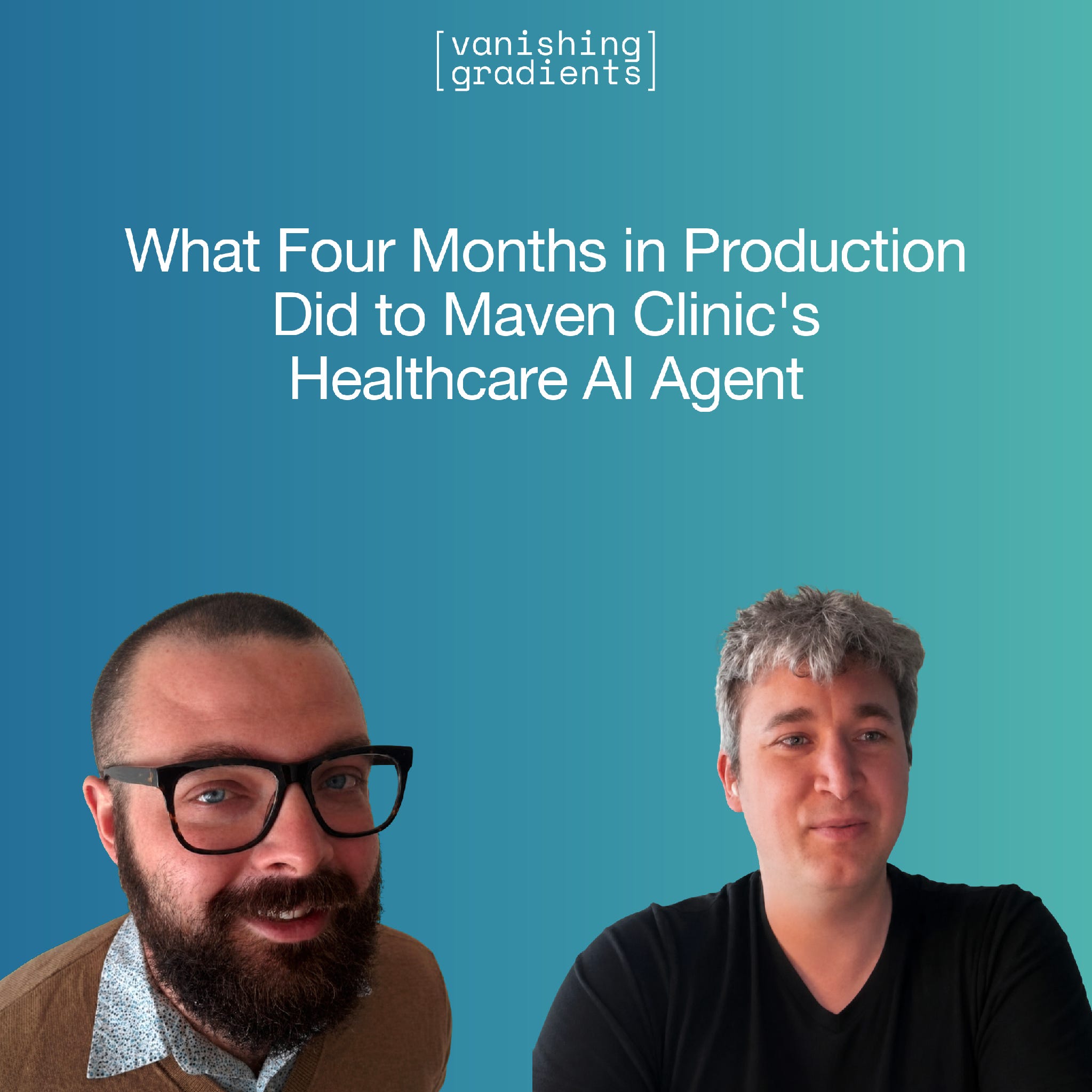
William Horton built Maven Assistant as a lead agent routing requests across four specialists, each with a small set of tools. Hard guardrails run before routing, while production failures become regression cases checked with deterministic tests and LLM judges. In Building an Enterprise AI Agent for Healthcare, William explains how the system works and why every capability needs its own release bar.
Four months ago, Maven had released the assistant to 20% of its users but withheld benefits answering, where a mistake could cost someone tens of thousands of dollars. Today it’s available to 100% of users, and benefits answering has shipped. Tomorrow, William is coming back to show us what production changed, what it took to clear that release bar, and which parts of the harness newer models allowed the team to remove.
Join us live on Jul 22, 2026 at 7pm EDT
Quick Links
What’s coming up, what just dropped, and how to plug in:
Live online events
Jul 22, 2026: What Four Months in Production Did to Maven Clinic’s Healthcare AI Agent with William Horton (Maven Clinic): what changed as Maven Assistant expanded from 20% to 100% of users, how benefits answering cleared its release bar, which production failures became evals, and what newer models allowed the team to simplify
Jul 23, 2026: Building Effective Agent Harnesses: a free Lightning Lesson mapping the agent loop, context, state, guardrails, traces, hooks, MCP, sub-agents, and feedback, with a look inside Pi, Codex, and Claude Code to decide which pieces your own harness needs
Jul 27, 2026: Reasoning Models, Local Agents, and Whatever Just Dropped with Sebastian Raschka, author of Build a Large Language Model (From Scratch) and Build a Reasoning Model (From Scratch): reasoning models, local-agent stacks, model internals, which recent ideas have held up, and whatever lands between now and then
Jul 28, 2026: Loop Engineering, Without the BS: a free Lightning Lesson on when repeated model calls improve a result, when an agent is grading its own homework, and how to build evaluation boundaries the loop can’t quietly rewrite
Jul 30, 2026: Show Us Your (Agent) Skills Ep. 08 with Chip Huyen, author of AI Engineering, and Tim Hopper, a machine learning infrastructure engineer at Spotify and creator of the Python Developer Tooling Handbook: the prompts, scripts, tools, and review loops they use with agents
Aug 13, 2026: Stop Shipping AI Nobody Can Verify with Hamel Husain (Parlance Labs): how provenance, visible calculations, inspectable evidence, and smaller review units make AI products easier to verify and trust
In-person events
Aug 10, 2026, Berlin: Build with AI: Berlin Meetup with Ines Montani (Explosion, spaCy) and Jodie Burchell: small, fast, data-private NLP systems, agent harnesses, five-minute demos, and time with other builders at JetBrains Berlin
Podcasts and recordings
Building an Enterprise AI Agent for Healthcare with William Horton (Maven Clinic): how Maven Assistant routes work across specialist agents, turns production failures into regression cases, combines deterministic checks with LLM judges, and sets release thresholds according to the consequences of being wrong. Listen to the podcast or watch on YouTube
Mining Agent Sessions, Evaluating Skills, and Building Better Verifiers with Greg Ceccarelli (SpecStory, ex-GitHub) and Han-Chung Lee (Moody’s, author of Evaluation and Alignment): mining traces for reusable skills, SkillsBench, deterministic verifiers, LLM judges, and deciding when an agent is actually done. Watch Show Us Your (Agent) Skills Ep. 07
How to Build a Coding Agent with Nicolay Gerold (Amp Code): a two-hour TypeScript build using Pi to expose the agent loop, tool execution, context management, and failure recovery beneath the polished interface. Watch on YouTube
What Claude Fable Means for Coding Agents with Nicolay Gerold (Amp Code): what survives in a coding-agent harness as stronger models absorb planning and orchestration, why Amp keeps deleting features, when loop engineering becomes a trap, and why TypeScript and Python give agents different feedback. Listen to the podcast or watch Coding Agents Are Dead: Long Live Coding Agents!
Agents, Context, and Feedback Systems with Matt Rocklin (Dask, Coiled) and Skylar Payne (Wicked Data, ex-Google, ex-LinkedIn): long-running agents, handwritten AGENTS.md, observability, personal assistants, memory, and human review queues for agents doing serious work. Watch Show Us Your (Agent) Skills Ep. 06
Agents Beyond the Terminal with John Berryman (Arcturus Labs, early GitHub Copilot engineer), Isaac Flath (Kentro Tech, ex-Answer.AI), and Matt Palmer (Conductor, ex-Replit): cross-app agents, local writing tools, browser video editing, laptop configuration as code, and the personal software that becomes worth building when agents lower the activation energy. Watch Show Us Your (Agent) Skills Ep. 05
The Verification Crisis: Why Trust Is the New Bottleneck in AI with Noah Smith (Noahpinion): whether agentic coding is increasing revenue per hour, what happens to software margins when products become cheap to clone, and why verification may become scarce in an economy flooded with generated work. Listen to High Signal
Blog posts and essays
Stop Overengineering Your Agent Harness: map the job by action complexity, context complexity, and the cost of being wrong before adding memory, planning, sub-agents, orchestration, and every other feature in the standard agent-framework shopping list
LLM Architecture in 2026: Agent Harnesses, Hybrid Models, and Why Implementation Does Not Lie with Sebastian Raschka: inference scaling, shrinking harnesses, hybrid architectures for cheaper long contexts, the economics of fine-tuning, and why matching intermediate tensors tests whether you truly understand a model. Listen to the podcast or watch on YouTube
Benchmarking AI Agents for Real Data Science: what happened when 150 people tried to use agents across SQL tables, logs, and 750,000 PDFs, and what the exercise revealed about evaluation, domain judgment, and whether an agent has solved a data-science problem
Courses
Jul 29, 2026: Build AI Agents from First Principles: build the core architecture behind a working customer-service agent and leave with starter code and a reusable way to decide when an agent is the right architecture, when a simpler workflow is enough, and how to make a tool-using system more reliable
Aug 4, 2026–Aug 13, 2026: Master Agentic Data Science with Thomas Wiecki and Luca Fiaschi (PyMC Labs): four live sessions on using agents across the data-science workflow without giving up statistical rigor, reproducibility, uncertainty, or human review
Aug 31, 2026–Sep 11, 2026: Build Production-Ready AI Agents for the Enterprise with Doug Turnbull, who led search at Reddit, Shopify, and Wikipedia: build an enterprise agent grounded in company knowledge, covering retrieval, context engineering, evaluation, automation, and deployment
Stop Overengineering Your Agent Harness
Claude Code’s harness is evidence about Claude Code. It isn’t a default architecture for every agent.
Yet ask what belongs in an agent harness and you often get the same shopping list: memory, planning, sub-agents, orchestration, hooks, guardrails, and evals.
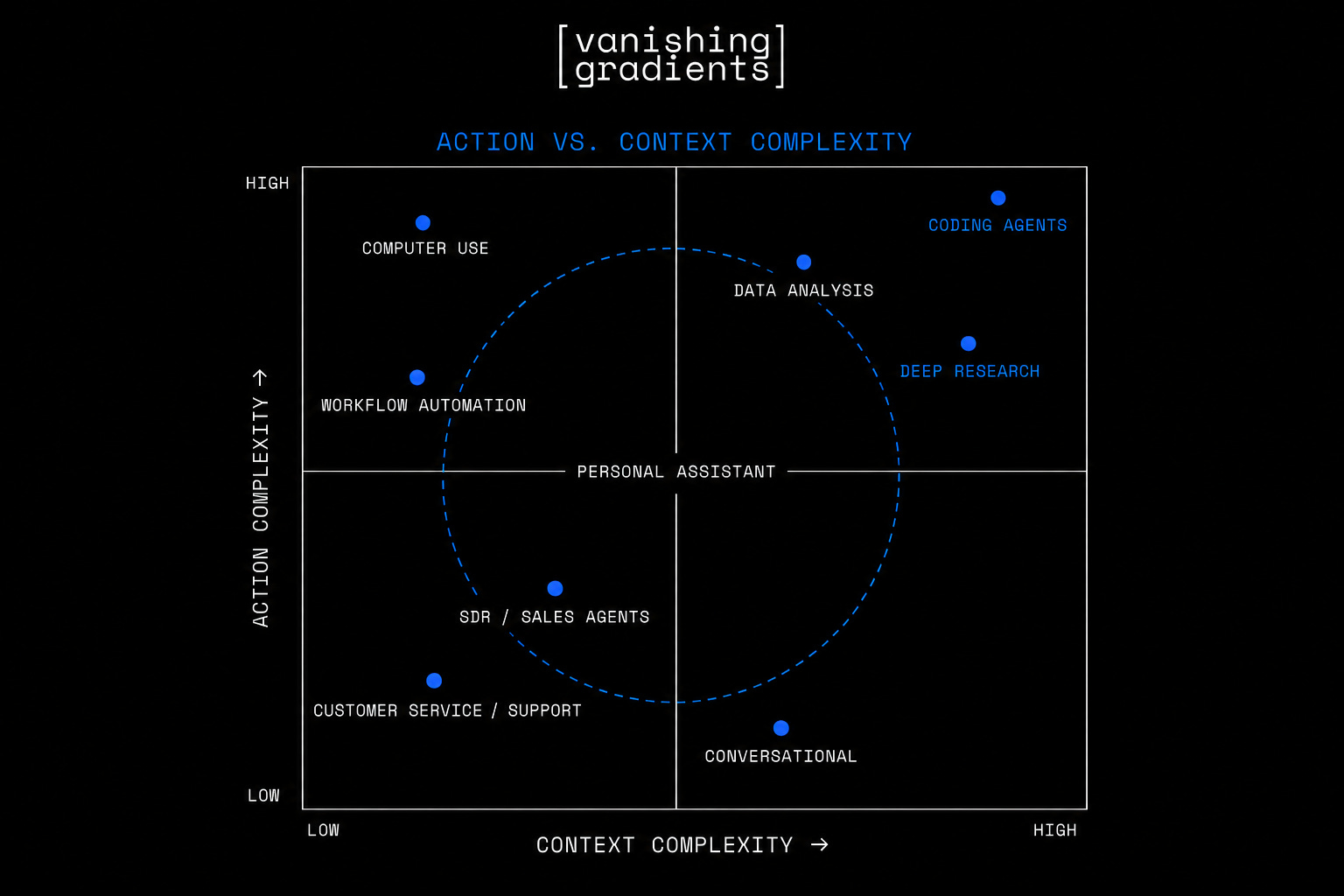
Before adding any of it, map the job by action complexity and context complexity. A coding agent is high on both. It edits files, runs tools, interprets failures, and carries state across many steps. A support agent may need only a few turns, careful routing, and a reliable handoff to a human.
Then ask what happens if it’s wrong. A one-turn agent that issues a refund may carry almost no context and still need strict permissions and human confirmation.
That gives us three questions: What must the agent do? What must it remember? What happens if it’s wrong?
That’s the argument in my new essay. It’s also how we’ll approach next week’s workshop: build the loop, understand each piece, and add complexity only when the job demands it.
Read Stop Overengineering Your Agent Harness
Build AI Agents from First Principles
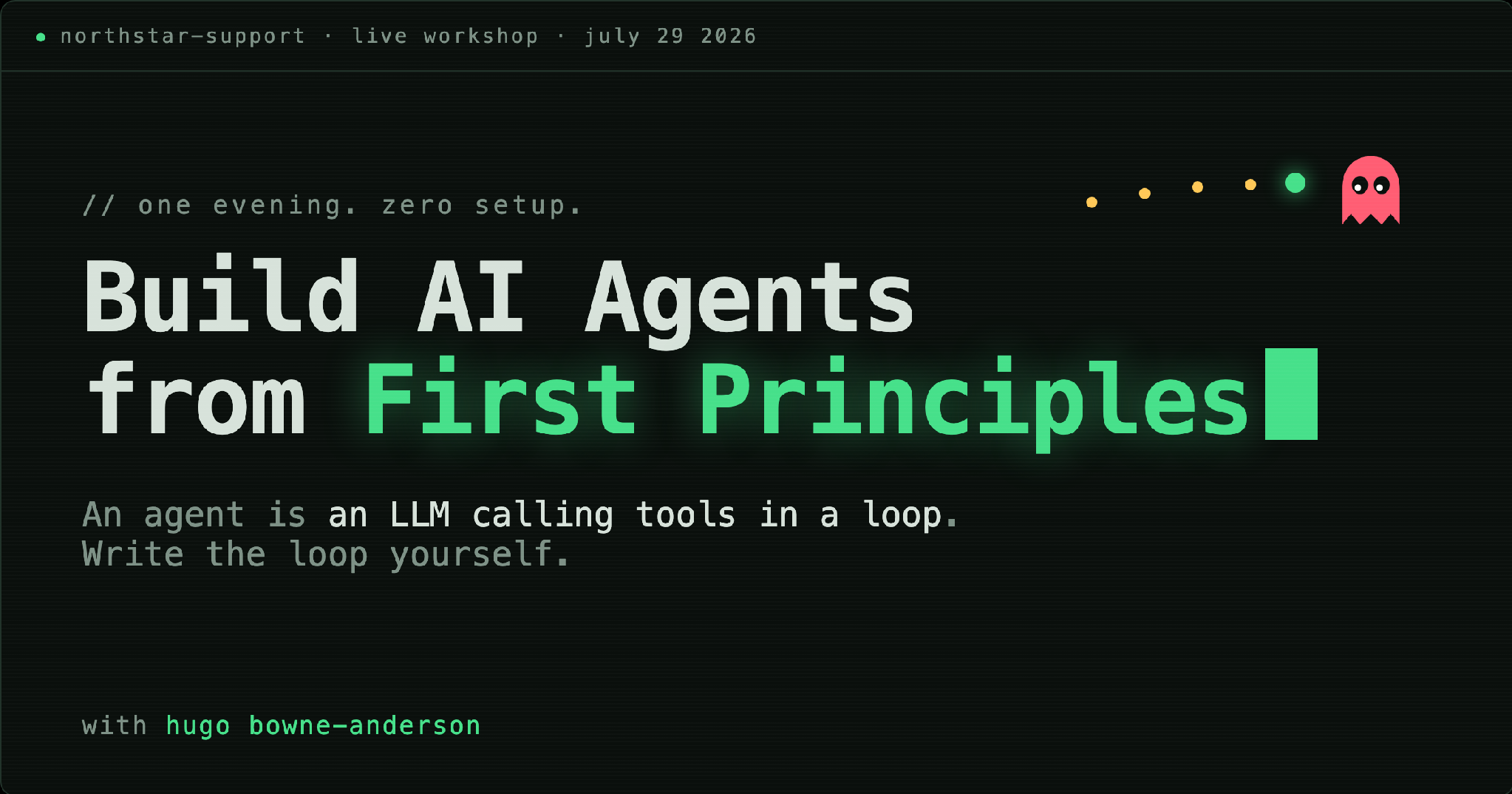
By the end of this workshop, you’ll have built an agent that can do useful work without being allowed to do whatever it wants.
It’ll look up orders, search company docs, file support tickets, and prepare refunds for a human to approve. Along the way, you’ll learn what belongs in the model, what belongs in code, and where you need a guardrail, an eval, or a human.
Starting with one model call, we’ll add the agent loop, tools, context, state, traces, feedback, and guardrails. One exercise ships with a deliberate failure: a request for bulk customer data slips through. You’ll read the trace, fix the right component, and rerun it without spending another token on the model.
Once the core system works, we’ll rebuild it with a modern agent SDK and connect its tools through MCP. You’ll see exactly what the framework handles and which decisions still belong to you.
You’ll leave with the working agent, starter code you can adapt to your own workflows, and a practical way to debug and improve it when it fails.
The workshop is live on Jul 29, 2026, 6–10pm EDT. Use code HARNESS10 for 10% off.
Join Build AI Agents from First Principles
Start with two free Lightning Lessons
Before the workshop, I’m teaching two free Lightning Lessons on the parts people most often overcomplicate: the harness around the model and the loop that drives it.
Building Effective Agent Harnesses
Agent frameworks have an impressive talent for making every new feature feel mandatory. Memory! Planning! Multi-agent orchestration! You ain’t gonna need most of it.
In this free lesson, we’ll start with a model call, give it tools, build the agent loop, and unpack the harness around it. We’ll look at context, state, guardrails, traces, hooks, MCP, sub-agents, and feedback, then examine how Pi, Codex, and Claude Code put these ideas to work.
The goal is to understand what each layer does, which problems it solves, and whether it belongs in the agent you’re actually building.
Register for Building Effective Agent Harnesses on Jul 23, 2026
Loop Engineering, Without the BS
The promise of loop engineering is incredible: give an agent a goal, let it work for hours, and come back to something better than any single pass could produce.
Sometimes that works. Sometimes the agent burns tokens, reinforces its own mistakes, rewrites the test, or produces a mountain of work nobody can review.
You’ll learn when to use autoresearch, when to use Ralph Wiggum loops, when to keep a human in the loop, and how to choose the goal, feedback, verifier, and stopping condition that keep the work improving rather than drifting.
Register for Loop Engineering, Without the BS on Jul 28, 2026
Both lessons are free. Register to join live or get the recording afterwards.
What Claude Fable Means for Coding Agents
What do coding agents look like in the age of Claude Fable and GPT-5.6?
Nicolay Gerold builds Amp, one of the best coding-agent harnesses out there. Every major model release forces the team to reconsider what belongs in the product, what the model can now handle itself, and which features should be deleted.
Amp built a handoff feature because compaction kept losing the plot in long-running threads. Then compaction improved, so they deleted it.
In the podcast What Claude Fable Means for Coding Agents, Nicolay and I get into what still belongs in the harness, which features better models are eating, when loop engineering creates more review work than value, why plan mode may be dead, and why TypeScript, Rust, and Python give agents different feedback.
Then, in the hands-on How to Build a Coding Agent workshop for builders, Nicolay and I build a modern coding agent from scratch with TypeScript and Pi. We expose the core loop, add tools and repository search, manage context across long-running tasks, recover from failures, and show how to use modern reasoning models without overengineering the harness.
Listen to What Claude Fable Means for Coding Agents or watch the conversation
Watch How to Build a Coding Agent
Reasoning Models, Local Agents, and Whatever Just Dropped with Sebastian Raschka
Reasoning Models, Local Agents, and Whatever Just Dropped with Sebastian Raschka.
When Sebastian Raschka and I last spoke in March, the model landscape already felt impossible to keep up with.
Since then, DeepSeek V4 arrived with a one-million-token context window and dedicated agentic-coding optimizations, GLM-5.2 pushed open models further into long-horizon work, and Kimi K3 launched with native vision, a one-million-token context window, and a focus on long-horizon coding, knowledge work, and reasoning. Qwen3.8-Max is now appearing in preview.
All of that happened in four months, and it amounts to more than benchmark churn. The models are getting better at holding enormous contexts together, using tools, writing code, reasoning for longer, and doing work that previously required more scaffolding around them.
As those capabilities move into the models, the boundary around the harness moves with them. Planning that once required application logic can happen inside the model, larger context windows change how much external memory and compaction we need, and better tool use can make yesterday’s orchestration code unnecessary or actively get in the way.
That leaves a set of practical questions about what still belongs in the harness, what we can now run locally, which architectural ideas are holding up, and what has already become obsolete.
Sebastian is coming back on Jul 27, 2026 to get underneath the new models, local-agent stacks, reasoning systems, and whatever else drops between now and then.
We’ll also be celebrating Sebastian’s new book, Build a Reasoning Model (From Scratch). Manning is giving ebook copies to the five people who ask the best questions during the livestream, and everyone in the Vanishing Gradients audience will get 45% off the book.
Register for Reasoning Models, Local Agents, and Whatever Just Dropped
To catch up, read LLM Architecture in 2026, listen to the podcast, or watch our previous conversation.
Show Us Your (Agent) Skills with Chip Huyen and Tim Hopper
Show Us Your (Agent) Skills with Chip Huyen and Tim Hopper.
Chip Huyen, author of AI Engineering, and Tim Hopper, a machine learning infrastructure engineer at Spotify and creator of the Python Developer Tooling Handbook, are joining Thomas Wiecki and me for the next Show Us Your (Agent) Skills. We’ll ask them to open up the prompts, scripts, tools, review loops, and working habits they use with agents.
In the latest episode, Greg Ceccarelli mined 516 saved agent sessions for practices worth turning into skills, then showed how Dead Reckon keeps coding agents working until hidden checks pass. Han-Chung Lee tested skills across different model-and-harness combinations and showed the nightly Codex job that links ideas across his multilingual Obsidian vault.
We turn each episode into things you can use. The new dossiers for Greg and Han collect their workflows, tools, screenshots, source links, and timestamped explanations. The open repo packages skills and workflows from across the series so you can read, copy, and adapt them.
Join us live with Chip Huyen and Tim Hopper on Jul 30, 2026
Build AI Agents from First Principles
The harness and loop ideas in this issue are the foundation for the workshop I’m teaching next week. You’ll build the core architecture behind an AI agent that can actually do useful work.
By the end, you’ll have a working customer-service agent, starter code you can adapt to your own work, and a reusable way to decide when an agent is the right architecture, when a simpler workflow is enough, and how to make a tool-using system more reliable.
The workshop is Jul 29, 2026, 6–10pm EDT, and registration closes Jul 28, 2026 at 10am EDT. Use code HARNESS10 for 10% off.
Join Build AI Agents from First Principles
Want to Support Vanishing Gradients?
Vanishing Gradients is independent, and most of the podcasts, livestreams, workshops, articles, guest dossiers, skills, and workflows I publish are free.
If you want to help keep it going:
Become a paid subscriber, from $8/month. Your subscription directly supports the podcast, workshops, newsletter, and open resources.
Share this issue with someone who builds with AI.
Subscribe to the Vanishing Gradients calendar for upcoming livestreams, workshops, and meetups.
Subscribe to the YouTube channel for full episodes, live builds, and recordings.
Work with me. I help teams build and improve AI-powered products. Hit reply if you want to talk.
Until next time ✌️
Hugo
What went the other way for me is verification. As the models absorbed more of the planning, the bottleneck moved to the one human in the loop. My agents run a books-to-travel product day and night, and what limits throughput is not tokens or orchestration, it is that everything still routes through me approving it. The harness feature I keep adding to, rather than deleting, is whatever makes a change reviewable in two minutes instead of twenty.
What happens if it is wrong is the question that gets skipped hardest, and it is the one that should decide the architecture. Most harness complexity I have added was really compensating for having no answer to it. I ship a small public skill pack solo, and the honest fix was almost never more orchestration. It was recording each step so a wrong answer was findable.